awsstepfuncs package
AWS Step Functions.
Submodules
awsstepfuncs.abstract_state module
Abstract state definitions.
Based on this table: https://states-language.net/spec.html#state-type-table
-
class
awsstepfuncs.abstract_state.AbstractInputPathOutputPathState(*args, input_path='$', output_path='$', **kwargs)¶ Bases:
awsstepfuncs.abstract_state.AbstractStateAn Amazon States Language state including InputPath and OutputPath.
input_path and output_path let you control what is input and output from a state by using Reference Paths.
-
compile()¶ Compile the state to Amazon States Language.
- Returns
A dictionary representing the compiled state in Amazon States Language.
- Return type
Dict[str, Any]
-
simulate(state_input, resource_to_mock_fn)¶ Simulate the state including input and output processing.
- Parameters
state_input (Any) – The input to the state.
resource_to_mock_fn (Dict[str, Callable]) – A mapping of resource URIs to mock functions to use if the state performs a task.
- Returns
The output of the state after applying any output processing.
- Return type
Any
-
-
class
awsstepfuncs.abstract_state.AbstractNextOrEndState(*args, input_path='$', output_path='$', **kwargs)¶ Bases:
awsstepfuncs.abstract_state.AbstractInputPathOutputPathStateAn Amazon States Language state including Next or End.
-
compile()¶ Compile the state to Amazon States Language.
- Returns
A dictionary representing the compiled state in Amazon States Language.
- Return type
Dict[str, Any]
-
-
class
awsstepfuncs.abstract_state.AbstractParametersState(*args, parameters=None, **kwargs)¶ Bases:
awsstepfuncs.abstract_state.AbstractResultPathStateAn Amazon States Language state including Parameters.
-
compile()¶ Compile the state to Amazon States Language.
- Returns
A dictionary representing the compiled state in Amazon States Language.
- Return type
Dict[str, Any]
-
-
class
awsstepfuncs.abstract_state.AbstractResultPathState(*args, result_path='$', **kwargs)¶ Bases:
awsstepfuncs.abstract_state.AbstractNextOrEndStateAn Amazon States Language state including ResultPath.
-
compile()¶ Compile the state to Amazon States Language.
- Returns
A dictionary representing the compiled state in Amazon States Language.
- Return type
Dict[str, Any]
-
simulate(state_input, resource_to_mock_fn)¶ Simulate the state including input and output processing.
- Parameters
state_input (Any) – The input to the state.
resource_to_mock_fn (Dict[str, Callable]) – A mapping of resource URIs to mock functions to use if the state performs a task.
- Returns
The output of the state after applying any output processing.
- Return type
Any
-
-
class
awsstepfuncs.abstract_state.AbstractResultSelectorState(*args, result_selector=None, **kwargs)¶ Bases:
awsstepfuncs.abstract_state.AbstractParametersStateAn Amazon States Language state including ResultSelector.
-
compile()¶ Compile the state to Amazon States Language.
- Returns
A dictionary representing the compiled state in Amazon States Language.
- Return type
Dict[str, Any]
-
simulate(state_input, resource_to_mock_fn)¶ Simulate the state including input and output processing.
- Parameters
state_input (Any) – The input to the state.
resource_to_mock_fn (Dict[str, Callable]) – A mapping of resource URIs to mock functions to use if the state performs a task.
- Returns
The output of the state after applying any output processing.
- Return type
Any
-
-
class
awsstepfuncs.abstract_state.AbstractRetryCatchState(*args, **kwargs)¶ Bases:
awsstepfuncs.abstract_state.AbstractResultSelectorStateAn Amazon States Language state including Retry and Catch.
-
add_catcher(error_equals, *, next_state)¶ Add a Catcher to the state.
When a state reports an error and either there is no Retrier, or retries have failed to resolve the error, the interpreter will try to find a relevant Catcher which determines which state to transition to.
“States.ALL” is the catch-all error message; that is, any error will be caught with “States.ALL”. Right now it’s the only error code supported when simulating.
If no catcher can be applied, then the state machine will terminate.
- Parameters
error_equals (List[str]) – A list of error names.
next_state (awsstepfuncs.abstract_state.AbstractState) – The name of the next state.
- Returns
Itself to allow for chaining.
- Return type
-
add_retrier(error_equals, *, interval_seconds=None, backoff_rate=None, max_attempts=None)¶ Add a Retrier to the state.
Retry the state by specifying a list of Retriers that describes the retry policy for different errors.
- Parameters
error_equals (List[str]) – A list of error names.
interval_seconds (Optional[int]) – The number of seconds before the first retry attempt. Defaults to 1 if not specified.
backoff_rate (Optional[float]) – A number which is the multiplier that increases the retry interval on each attempt. Defaults to 2.0 if not specified.
max_attempts (Optional[int]) – The maximum number of retry to attempt. Defaults to 3 if not specified. A value of zero means that the error should never be retried.
- Returns
Itself to allow for chaining.
- Return type
-
compile()¶ Compile the state to Amazon States Language.
- Returns
A dictionary representing the compiled state in Amazon States Language.
- Return type
Dict[str, Any]
-
-
class
awsstepfuncs.abstract_state.AbstractState(name, comment=None)¶ Bases:
abc.ABCAn Amazon States Language state including Name, Comment, and Type.
-
compile()¶ Compile the state to Amazon States Language.
- Returns
A dictionary representing the compiled state in Amazon States Language.
- Return type
Dict[str, Any]
-
simulate(state_input, *, resource_to_mock_fn)¶ Simulate the state including input and output processing.
- Parameters
state_input (Any) – The input to the state.
resource_to_mock_fn (Dict[str, Callable]) – A mapping of resource URIs to mock functions to use if the state performs a task.
- Returns
The output of the state after applying any output processing.
- Return type
Any
-
awsstepfuncs.choice module
-
class
awsstepfuncs.choice.AbstractChoice(next_state)¶ Bases:
abc.ABCChoices for Choice State.
-
evaluate(data)¶ Evaulate the choice on some given data.
- Parameters
data (Any) – Input data to evaluate.
- Raises
NotImplementedError – Raised if not implemented in child classes.
- Return type
bool
-
-
class
awsstepfuncs.choice.AndChoice(choice_rules, *, next_state)¶ Bases:
awsstepfuncs.choice.AbstractChoiceAnd Choice for the Choice State.
The And Choice can be evaluated based on input data to true or false based on whether all Choice Rules are true.
-
evaluate(data)¶ Evaulate the And Choice on some given data.
- Parameters
data (Any) – Input data to evaluate.
- Returns
Whether the choice evaluates to true based on the input data.
- Return type
bool
-
-
class
awsstepfuncs.choice.ChoiceRule(variable, **data_test_expression)¶ Bases:
objectChoice Rules are used in Choices.
When initializing a Choice Rule, a data test expression must be provided. A Choice Rule evalulates to True or False based on the data-test expression on some data.
-
evaluate(data)¶ Evaulate the Choice Rule with a data-test expression on some data.
- Parameters
data (Any) – Input data to evaluate.
- Returns
True or false based on the data and the Choice Rule.
- Return type
bool
-
-
class
awsstepfuncs.choice.DataTestExpression(type, expression)¶ Bases:
objectA data-test expression.
-
class
awsstepfuncs.choice.DataTestExpressionType(value)¶ Bases:
enum.EnumAll the different types of data-test expressions.
Check section “Data-test expression” for a full list: https://states-language.net/#choice-state
-
BOOLEAN_EQUALS= 'boolean_equals'
-
BOOLEAN_EQUALS_PATH= 'boolean_equals_path'
-
IS_BOOLEAN= 'is_boolean'
-
IS_NULL= 'is_null'
-
IS_NUMERIC= 'is_numeric'
-
IS_PRESENT= 'is_present'
-
IS_STRING= 'is_string'
-
IS_TIMESTAMP= 'is_timestamp'
-
NUMERIC_EQUALS= 'numeric_equals'
-
NUMERIC_EQUALS_PATH= 'numeric_equals_path'
-
NUMERIC_GREATER_THAN= 'numeric_greater_than'
-
NUMERIC_GREATER_THAN_EQUALS= 'numeric_greater_than_equals'
-
NUMERIC_GREATER_THAN_EQUALS_PATH= 'numeric_greater_than_equals_path'
-
NUMERIC_GREATER_THAN_PATH= 'numeric_greater_than_path'
-
NUMERIC_LESS_THAN= 'numeric_less_than'
-
NUMERIC_LESS_THAN_EQUALS= 'numeric_less_than_equals'
-
NUMERIC_LESS_THAN_EQUALS_PATH= 'numeric_less_than_equals_path'
-
NUMERIC_LESS_THAN_PATH= 'numeric_less_than_path'
-
STRING_EQUALS= 'string_equals'
-
STRING_EQUALS_PATH= 'string_equals_path'
-
STRING_GREATER_THAN= 'string_greater_than'
-
STRING_GREATER_THAN_EQUALS= 'string_greater_than_equals'
-
STRING_GREATER_THAN_EQUALS_PATH= 'string_greater_than_equals_path'
-
STRING_GREATER_THAN_PATH= 'string_greater_than_path'
-
STRING_LESS_THAN= 'string_less_than'
-
STRING_LESS_THAN_EQUALS= 'string_less_than_equals'
-
STRING_LESS_THAN_EQUALS_PATH= 'string_less_than_equals_path'
-
STRING_LESS_THAN_PATH= 'string_less_than_path'
-
STRING_MATCHES= 'string_matches'
-
TIMESTAMP_EQUALS= 'timestamp_equals'
-
TIMESTAMP_EQUALS_PATH= 'timestamp_equals_path'
-
TIMESTAMP_GREATER_THAN= 'timestamp_greater_than'
-
TIMESTAMP_GREATER_THAN_EQUALS= 'timestamp_greater_than_equals'
-
TIMESTAMP_GREATER_THAN_EQUALS_PATH= 'timestamp_greater_than_equals_path'
-
TIMESTAMP_GREATER_THAN_PATH= 'timestamp_greater_than_path'
-
TIMESTAMP_LESS_THAN= 'timestamp_less_than'
-
TIMESTAMP_LESS_THAN_EQUALS= 'timestamp_less_than_equals'
-
TIMESTAMP_LESS_THAN_EQUALS_PATH= 'timestamp_less_than_equals_path'
-
TIMESTAMP_LESS_THAN_PATH= 'timestamp_less_than_path'
-
-
class
awsstepfuncs.choice.NotChoice(variable, *, next_state, **data_test_expression)¶ Bases:
awsstepfuncs.choice.AbstractChoiceNot choice for the Choice State.
The Not Choice can be evaluated based on input data to true or false based on whether the Choice Rule is false.
-
evaluate(data)¶ Evaulate the Not Choice on some given data.
- Parameters
data (Any) – Input data to evaluate.
- Returns
Whether the choice evaluates to true based on the input data.
- Return type
bool
-
-
class
awsstepfuncs.choice.VariableChoice(variable, *, next_state, **data_test_expression)¶ Bases:
awsstepfuncs.choice.AbstractChoiceVariable Choice for the Choice State.
The Variable Choice can be evaluated based on input data to true or false based on whether the Choice Rule is true.
Be careful if you use a Reference Path that it evaluates to the correct type.
-
evaluate(data)¶ Evaulate the Variable Choice on some given data.
- Parameters
data (Any) – Input data to evaluate.
- Returns
Whether the choice evaluates to true based on the input data.
- Return type
bool
-
awsstepfuncs.error_handlers module
-
class
awsstepfuncs.error_handlers.AbstractErrorHandler(error_equals)¶ Bases:
abc.ABCError handlers compose of Retriers and Catchers.
-
compile()¶ Compile the error handler with error_equals handled.
- Returns
A compilation with error_equals compiled.
- Return type
Dict[str, Any]
-
-
class
awsstepfuncs.error_handlers.Catcher(error_equals, next_state)¶ Bases:
awsstepfuncs.error_handlers.AbstractErrorHandlerUsed to go from an errored state to another state.
-
compile()¶ Compile the Catcher to Amazon States Language.
- Returns
A Catcher in Amazon States Language.
- Return type
Dict[str, Union[List[str], str]]
-
-
class
awsstepfuncs.error_handlers.Retrier(error_equals, interval_seconds=None, backoff_rate=None, max_attempts=None)¶ Bases:
awsstepfuncs.error_handlers.AbstractErrorHandlerUsed to retry a failed state given the error names.
-
compile()¶ Compile the Retrier to Amazon States Language.
- Returns
A Retrier in Amazon States Language.
- Return type
Dict[str, Union[List[str], int, float]]
-
awsstepfuncs.errors module
-
exception
awsstepfuncs.errors.AWSStepFuncsError¶ Bases:
ExceptionBase error for this package.
This is useful for client code to know whether the error is expected or whether there is a bug in the library code.
>>> from awsstepfuncs import *
>>> try:
...     wait_state = WaitState("Wait!", seconds=-1)
... except AWSStepFuncsError:
...     print("Error in the client")
... except Exception:
...     print("Error in awsstepfuncs")
Error in the client
-
exception
awsstepfuncs.errors.AWSStepFuncsValueError¶ Bases:
awsstepfuncs.errors.AWSStepFuncsErrorA bad value was specified.
>>> from awsstepfuncs import *
>>> wait_state = WaitState("Wait!", seconds=-1)
Traceback (most recent call last):
    ...
awsstepfuncs.errors.AWSStepFuncsValueError: seconds must be greater than zero
-
exception
awsstepfuncs.errors.FailStateError(*, error, cause)¶ Bases:
awsstepfuncs.errors.StateSimulationErrorRaised when running a Fail State.
- Parameters
error (str) –
cause (str) –
-
exception
awsstepfuncs.errors.NoChoiceMatchedError¶ Bases:
awsstepfuncs.errors.StateSimulationErrorRaised when a Choice State failed to pick a next state.
-
error_string= 'States.NoChoiceMatched'
-
-
exception
awsstepfuncs.errors.StateSimulationError¶ Bases:
awsstepfuncs.errors.AWSStepFuncsErrorRaised when there is an error while simulating a state.
Check this table for a list of state simulation errors: https://states-language.net/spec.html#appendix-a
-
error_string= 'States.ALL'
-
static
from_string(error_string)¶ Convert a state simulation error string to an error class.
>>> StateSimulationError.from_string("States.Timeout")
<class 'awsstepfuncs.errors.StateTimeoutError'>
If no value is returned, then the error cannot be simulated.
>>> StateSimulationError.from_string("States.Permissions") is None
True
- Parameters
error_string (str) – The error string, such as “States.ALL”.
- Returns
The error class if the error can be simulated.
- Return type
Optional[Type[awsstepfuncs.errors.StateSimulationError]]
-
-
exception
awsstepfuncs.errors.StateTimeoutError¶ Bases:
awsstepfuncs.errors.StateSimulationErrorRaised when the state has timed out while simulating.
A Task State either ran longer than the “TimeoutSeconds” value, or failed to heartbeat for a time longer than the “HeartbeatSeconds” value.
-
error_string= 'States.Timeout'
-
-
exception
awsstepfuncs.errors.TaskFailedError¶ Bases:
awsstepfuncs.errors.StateSimulationErrorRaised when the task has failed during the execution.
-
error_string= 'States.TaskFailed'
-
awsstepfuncs.printer module
-
class
awsstepfuncs.printer.Color(value)¶ Bases:
enum.EnumWrap Colorama’s colors to make typing easier for the user.
Refs: https://github.com/tartley/colorama/blob/master/colorama/ansi.py#L49 (AnsiFore class)
-
BLACK= 1
-
BLUE= 5
-
CYAN= 7
-
GREEN= 3
-
LIGHTBLACK_EX= 9
-
LIGHTBLUE_EX= 13
-
LIGHTCYAN_EX= 15
-
LIGHTGREEN_EX= 11
-
LIGHTMAGENTA_EX= 14
-
LIGHTRED_EX= 10
-
LIGHTWHITE_EX= 16
-
LIGHTYELLOW_EX= 12
-
MAGENTA= 6
-
RED= 2
-
WHITE= 8
-
YELLOW= 4
-
-
class
awsstepfuncs.printer.Printer(colorful=False)¶ Bases:
objectPrint simulation messages to STDOUT.
awsstepfuncs.reference_path module
-
class
awsstepfuncs.reference_path.ReferencePath(reference_path, /)¶ Bases:
objectReference Path validation and application.
Reference Path is a specialized JSONPath. Unlike a JSONPath, the Reference Path must be unambiguous and evaluate to only a single node.
More on Reference Paths: https://states-language.net/spec.html#ref-paths More on JSONPath: https://github.com/json-path/JsonPath
-
apply(data)¶ Parse then apply a Reference Path on some data.
- Parameters
data (dict) – The data to use the Reference Path expression on.
- Returns
The queried data.
- Return type
Any
-
awsstepfuncs.state module
State definitions.
Class structure based on this table: https://states-language.net/spec.html#state-type-table
Each row in the table is its own ABC. All latter rows inherit from previous rows. States (the columns) are concrete classes that inherit from the ABC that has the right fields available.
Each concrete class should implement its own _execute() method that will Execute the state according to its business logic when running a simulation. Each concrete class should also define a constant class variable called state_type that corresponds to type in Amazon States Language.
There are two interesting methods common for many classes: - simulate(): Simulate the state including input/output processing - _execute(): Execute the state, eg. for a Wait State, wait the designated time
-
class
awsstepfuncs.state.ChoiceState(*args, choices, default=None, **kwargs)¶ Bases:
awsstepfuncs.state.TerminalStateMixin,awsstepfuncs.abstract_state.AbstractInputPathOutputPathStateA Choice State adds branching logic to a state machine.
-
compile()¶ Compile the state to Amazon States Language.
- Returns
A dictionary representing the compiled state in Amazon States Language.
- Return type
Dict[str, Any]
-
state_type= 'Choice'
-
-
class
awsstepfuncs.state.FailState(*args, error, cause, **kwargs)¶ Bases:
awsstepfuncs.state.TerminalStateMixin,awsstepfuncs.abstract_state.AbstractStateThe Fail State terminates the machine and marks it as a failure.
-
compile()¶ Compile the state to Amazon States Language.
- Returns
A dictionary representing the compiled state in Amazon States Language.
- Return type
Dict[str, Any]
-
state_type= 'Fail'
-
-
class
awsstepfuncs.state.MapState(*args, iterator, items_path='$', max_concurrency, **kwargs)¶ Bases:
awsstepfuncs.abstract_state.AbstractRetryCatchStateThe Map State processes all the elements of an array.
-
compile()¶ Compile the state to Amazon States Language.
- Returns
A dictionary representing the compiled state in Amazon States Language.
- Return type
Dict[str, Any]
-
state_type= 'Map'
-
-
class
awsstepfuncs.state.ParallelState(*args, **kwargs)¶ Bases:
awsstepfuncs.abstract_state.AbstractRetryCatchStateThe Parallel State causes parallel execution of branches.
-
state_type= 'Parallel'
-
-
class
awsstepfuncs.state.PassState(*args, result=None, **kwargs)¶ Bases:
awsstepfuncs.abstract_state.AbstractParametersStateThe Pass State by default passes its input to its output, performing no work.
If result is passed, its value is treated as the output of a virtual task.
If result_path is specified, the result will be placed on that Reference Path.
-
compile()¶ Compile the state to Amazon States Language.
- Returns
A dictionary representing the compiled state in Amazon States Language.
- Return type
Dict[str, Any]
-
state_type= 'Pass'
-
-
class
awsstepfuncs.state.SucceedState(*args, input_path='$', output_path='$', **kwargs)¶ Bases:
awsstepfuncs.state.TerminalStateMixin,awsstepfuncs.abstract_state.AbstractInputPathOutputPathStateThe Succeed State terminates with a mark of success.
The Succeed State’s output is the same as its input.
-
state_type= 'Succeed'
-
-
class
awsstepfuncs.state.TaskState(*args, resource, timeout_seconds=None, **kwargs)¶ Bases:
awsstepfuncs.abstract_state.AbstractRetryCatchStateThe Task State executes the work identified by the Resource field.
-
compile()¶ Compile the state to Amazon States Language.
- Returns
A dictionary representing the compiled state in Amazon States Language.
- Return type
Dict[str, Any]
-
state_type= 'Task'
-
-
class
awsstepfuncs.state.TerminalStateMixin¶ Bases:
abc.ABCA mixin for blocking rshift for terminal states.
-
class
awsstepfuncs.state.WaitState(*args, seconds=None, timestamp=None, seconds_path=None, timestamp_path=None, **kwargs)¶ Bases:
awsstepfuncs.abstract_state.AbstractNextOrEndStateA Wait State causes the interpreter to delay the machine for a specified time.
You can specify a timestamp to wait until. If the time has already past, then there is no wait.
Alternatively, you can use state input to specify the number of seconds wait by specifying a Reference Path seconds_path.
Similarily, you can use state input to specify the timestamp (in ISO 8601 format) to wait until.
Exactly one must be defined: seconds, timestamp, seconds_path, timestamp_path.
Refs: https://states-language.net/#wait-state
-
compile()¶ Compile the state to Amazon States Language.
- Returns
A dictionary representing the compiled state in Amazon States Language.
- Return type
Dict[str, Any]
-
state_type= 'Wait'
-
awsstepfuncs.state_machine module
-
class
awsstepfuncs.state_machine.StateMachine(*, start_state, comment=None, version=None)¶ Bases:
objectAn AWS Step Functions state machine.
-
property
all_states¶ Return all states in the state machine.
- Returns
A set of all possible states in the state machine.
-
compile()¶ Compile a state machine to Amazon States Language.
- Returns
A dictionary of the compiled state in Amazon States Language.
- Return type
Dict[str, Any]
-
simulate(state_input=None, /, *, resource_to_mock_fn=None, show_visualization=False, visualization_output_path='state_machine.gif', colorful=False)¶ Simulate the state machine by executing all of the states.
- Parameters
state_input (Optional[dict]) – Data to pass to the first state.
resource_to_mock_fn (Optional[Dict[str, Callable]]) – A dictionary mapping Resource URI to a mock function to use in the simulation.
show_visualization (bool) – Whether or not to create an animated GIF visualization of the state machine when simulating. Outputs to state_machine.gif.
visualization_output_path (str) – If show_visualization is set to True, what path to save the visualization GIF to.
colorful (bool) – Whether to make the simulation STDOUT messages ✨pop✨.
- Returns
The final output state from simulating the state machine.
- Return type
Any
-
to_json(filename)¶ Compile to Amazon States Language and then output to JSON.
- Parameters
filename (Union[str, pathlib.Path]) – The name of the file to write the JSON to.
- Return type
None
-
property
awsstepfuncs.types module
awsstepfuncs.visualization module
-
class
awsstepfuncs.visualization.Visualization(*, start_state, output_path='state_machine.gif')¶ Bases:
objectCreate a visualization of a state machine.
Here’s a few examples of visualizations using show_visualization=True:
resource = "123"
task_state = TaskState("My task", resource=resource)
succeed_state = SucceedState("Success")
pass_state = PassState("Just passing")
fail_state = FailState("Failure", error="IFailed", cause="I failed!")

task_state >> succeed_state
pass_state >> fail_state

task_state.add_catcher(["States.ALL"], next_state=pass_state)

state_machine = StateMachine(start_state=task_state)

def failure_mock_fn(event, context):
    assert False

state_machine.simulate(
    resource_to_mock_fn={resource: failure_mock_fn}, show_visualization=True
)
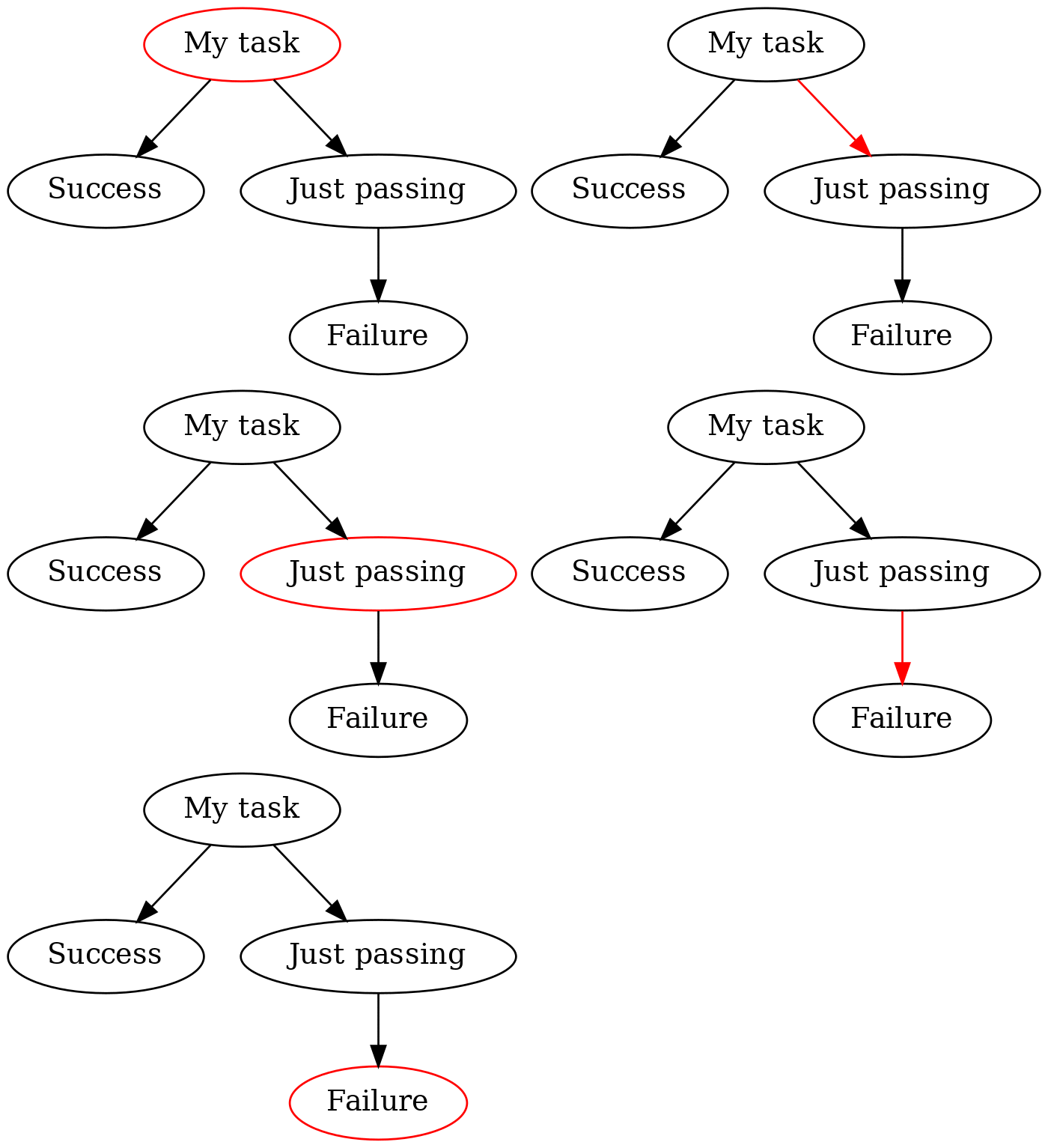
state_machine.gif
A choice state:
public_state = PassState("Public")
value_in_twenties_state = PassState("ValueInTwenties")
after_value_in_twenties_state = SucceedState("Success!")
start_audit_state = PassState("StartAudit")

value_in_twenties_state >> after_value_in_twenties_state

choice_state = ChoiceState(
    "DispatchEvent",
    choices=[
        NotChoice(
            variable="$.type",
            string_equals="Private",
            next_state=public_state,
        ),
        AndChoice(
            [
                ChoiceRule(variable="$.value", is_present=True),
                ChoiceRule(variable="$.value", numeric_greater_than_equals=20),
                ChoiceRule(variable="$.value", numeric_less_than=30),
            ],
            next_state=value_in_twenties_state,
        ),
        VariableChoice(
            variable="$.rating",
            numeric_greater_than_path="$.auditThreshold",
            next_state=start_audit_state,
        )
    ],
)

state_machine = StateMachine(start_state=choice_state)
state_machine.simulate(
    {"type": "Private", "value": 22}, show_visualization=True
)
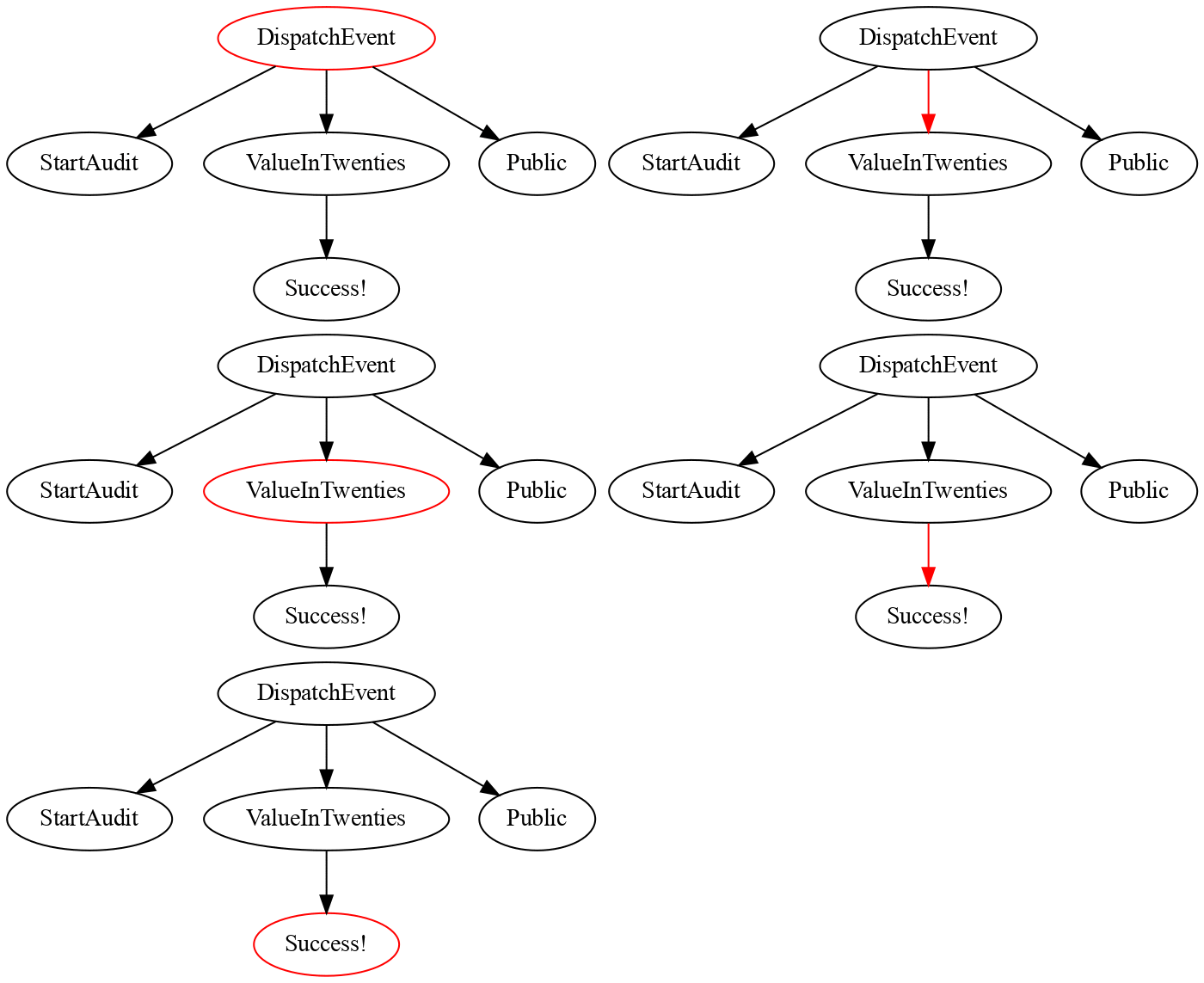
state_machine.gif
A choice state when the default is chosen:
record_event_state = PassState("RecordEvent")

choice_state = ChoiceState(
    "DispatchEvent",
    choices=[
        NotChoice(
            variable="$.type",
            string_equals="Private",
            next_state=public_state,
        ),
        AndChoice(
            [
                ChoiceRule(variable="$.value", is_present=True),
                ChoiceRule(variable="$.value", numeric_greater_than_equals=20),
                ChoiceRule(variable="$.value", numeric_less_than=30),
            ],
            next_state=value_in_twenties_state,
        ),
        VariableChoice(
            variable="$.rating",
            numeric_greater_than_path="$.auditThreshold",
            next_state=start_audit_state,
        )
    ],
    default=record_event_state,
)
state_machine = StateMachine(start_state=choice_state)
state_machine.simulate(
    {"type": "Private", "value": 102, "auditThreshold": 150},
    show_visualization=True
)
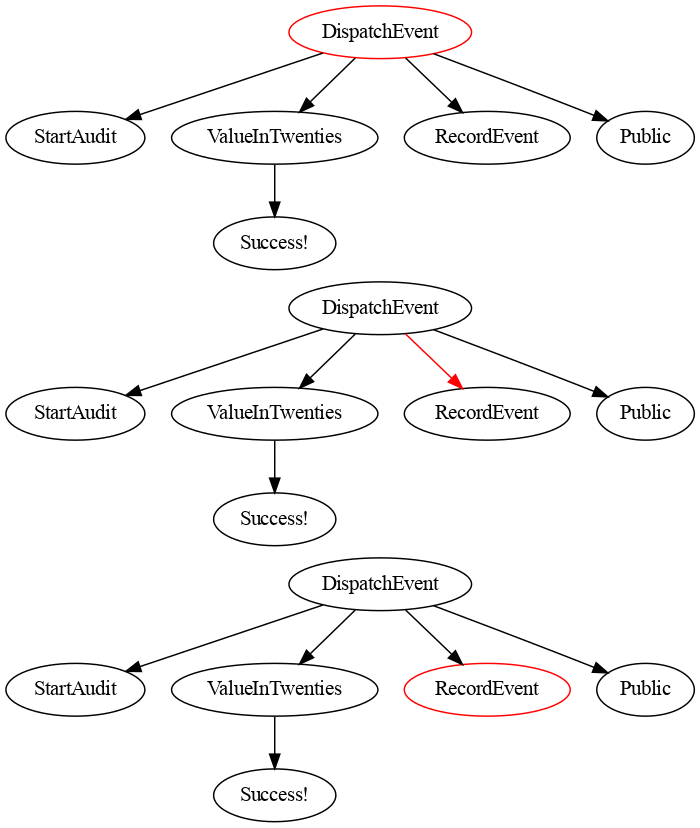
state_machine.gif
-
highlight_state(state)¶ Highlight a state.
- Parameters
state (awsstepfuncs.abstract_state.AbstractState) – The state to highlight, unique by name.
- Return type
None
-
highlight_state_transition(previous_state, next_state)¶ Highlight the transition between two states.
- Parameters
previous_state (awsstepfuncs.abstract_state.AbstractState) – The previous state.
next_state (awsstepfuncs.abstract_state.AbstractState) – The next state.
- Return type
None
-
render()¶ Render the state machine visualization to a GIF file.
- Return type
None
-